Something is stealing my brain.I’ll bet it’s stealing yours, too.Its goal is to keep me from focusing.It doesn’t want my mind to give concentrated attention to anything.Not to the book in front of me.Not to the presenter trying to offer a lecture.Not to the road I’m driving down.Not to the environment around me.Not to my cat.Especially not to God.Especially not to prayer or meditation or Bible study.
It started with cell phones.I remember how strange it was when I started hearing people talking on cell phones regularly.I remember where I was.I was at a gas station filling up my car.There were 3 other cars at the pump with me.And two of the other people started talking, so I assumed they were talking to me, but, no, they were on cell phones.The four of us were all standing within 20 feet of each other, but none of us was really there.
Then it was the Internet.My first step away from a typewriter was a word processor, which I thought was about the most incredible device ever.It had this funky orange screen and you could type on it and then push a button and it would print out pages using this special paper that allowed you to burn words into it.Absolutely amazing.But it didn’t do anything else.
Now on my computer there is the constant temptation to check email.Check my Facebook.Chat with people.Check the sports scores.Watch the dancing baby video on YouTube.Giving the project in front of me my full attention is an effort.A challenge.A chore.Giving that sort of attention to God?It can seem like a fantasy.Can you relate?Something is stealing our brains and we are letting it happen.
So today we’re starting a focus in worship that I’m kind of calling the Truly, Madly, Deeply series. That was the name of a romantic comedy awhile back but I want to use those three adverbs as a way to describe the kind of love I want to have for God again. I don’t want a superficial relationship with God.I don’t want to settle for an occasional glancing reference to Jesus. I don’t want to blog about my relationship to God.I don’t want to refer to it as though it were an old fling that I’ve outgrown. I don’t want to be a stranger to God.I don’t want to settle for a kind of faux friendship – like maybe God is somebody I allow to see my profile on Facebook and to whom I’ll occasionally tweet but never really talk to. God deserves more than 140 characters of my life.I want to fall truly, madly, deeply in love with Her. And here’s the thing – I know God wants the same thing and has built me to love that way.
It’s easy to forget that we’re made that way. We like to think we can make it on our own and that we don’t need a relationship like that. We’re Americans, right?We pull ourselves up by our own bootstraps. Wasn’t that the essence of the Horatio Alger stories of the 19th century?
Believing that has given us a great optimism about the future and a great sense of potential, but it can have some nasty side effects. There’s a scene in the television show The Simpsons where Bart Simpson finds himself sitting down to dinner with his family and the pastor of their church. He’s asked to give the blessing and his father groans, knowing that Bart is bound to say something inappropriate. Sure enough, what Bart prays is: “Thank you, God, for nothing. We worked hard to earn the money for this food.We bought it at the store and my mom cooked it. Amen.”
In its own satirical way, The Simpsons was pointing out what happens when we become a forgetful people. It’s the same danger Moses warned the people of Israel about when they were heading into the Promised Land after years of wandering in the wilderness. In Deuteronomy chapter 8, verse 17 Moses says, “Do not say to yourself, ‘My power and the might of my own hand have gotten me this wealth.’ But remember the LORD your God, for it is he who gives you power to get wealth.”
We think we can do it on our own. We think we don’t need to be grateful. We think we don’t have to return to the center, to return to God. We think that to love God truly, madly, deeply is to be weak or foolish or naïve. We think we can do it on.We think we have to do it on our own.We’ve been burned so often by things and people in which we placed our trust that we can’t risk going there again. We are told that we can’t trust others and maybe we feel like we can’t trust God. Have you ever felt this?
Jesus was starting to walk towards Jerusalem. He’s moving away from Galilee where he has been teaching and we know where he’s going. We know what Jerusalem means.It means the cross.It means the humiliation. It means the suffering.It means death.But it’s where Jesus has to go.It’s where God is going to set all things right.
So Jesus moves along on the border between Samaria and Galilee and he comes to a village where there are ten men standing at a distance and they are united by just one thing – they all have leprosy, a hideous skin disease. But it’s not just the disease that’s the problem.In Jesus’ day having leprosy meant a long, slow death and lifetime living on the edges of the village. People with leprosy were considered unclean.People with leprosy, if they touched anyone else, could make others unclean. These were isolated men who respected Jesus by keeping their distance when they called out to him.
But let me tell you what lepers know. People with leprosy didn’t have any illusions about who they were or what it took to survive. They could not believe that they could make it on their own because their illness forced them to see something that it takes some other people a lifetime to realize – that they were absolutely dependent on a community that could provide what little resources they could beg from them. Survival on their own was not an option.They knew their limits and they knew that it would take something bigger than themselves to get by.
Jesus saw them, but he didn’t heal them right away. No, he tells them to go show themselves to the priest, which is what you would do if you hoped to be declared clean from a skin disease. On the way to the priest, they were all healed.Their exile was over.They could now go on to live.
One of the men paused before beginning his new life, though. Just one.He turned around and went back to Jesus. He wasn’t even a member of Jesus’ race. He was a Samaritan and not a Jew. But that’s the one that returned and fell down at Jesus’ feet. He could fall down at Jesus’ feet now!He didn’t have to call from a distance. He didn’t have to holler out for mercy from the edges of the crowd. He could fall down at Jesus’ feet and he did.He praised God and he thanked Jesus.Truly, madly, deeply.
Jesus was startled.At least he seemed to be. He was startled to see who had come back – this foreigner whom Jews considered to be outside the covenant with God. But he said to the man, “Get up and go on your way. Your faith has made you whole.”The Samaritan had found his way to true wholeness. He hadn’t just been healed; he had gotten in touch with something much deeper. He had gotten in touch with that part of himself that was restlessly waiting to respond to God and to connect him to the grace that makes all things new.
How do I know that there is such a place in the human heart? How do I know that we are made that way? Because the Bible tells me so.Psalm 65, my favorite psalm, begins with words that can be translated like this: “For you, praise waits in still repose, God.” For you, praise is waiting.There is a place within me, within you that needs to praise the living God. There is within me a place waiting to respond to grace. There is within me a song of joy that needs to be lifted up and a hymn of thanksgiving to be sung. ‘There’s within my heart a melody, Jesus whispers sweet and low. Fear not, I am with thee, peace, be still, in all of life’s ebb and flow’?Do you know what I’m talking about?
And we are letting the Internet eat our brains?We are letting the distractions of this life take away that joy? When what our souls desire more than anything else is to love God truly, madly, deeply.
O, I know, there are cares and woes, aren’t there? There are trials and temptations, aren’t there? There are losses we grieve, loved ones that we miss.There are dreams yet unfulfilled and there are moments of darkness and despair. There are relationships that need mending and challenges that need tending. There are addictions we can’t seem to overcome and there are children who worry us, parents who just can’t understand. There are money woes and school issues.There is low self-esteem and high gas prices.There are moral failings and unfinished business. There are cats.There are so many things that can keep us from God.
That’s not all there is, though, is it? You know your blessings.You know that if you wanted to or needed to you could start counting them this moment and never finish. Some of them are as obvious as the sun in the morning sky. And some are unseen but no less real.
You don’t have to count your blessings, though, to know how grateful you are. All you have to do is look into your heart, because praise is waiting there. God is waiting there and even if we lost all the world, we would not lose this grateful heart because it was given to us by Jesus Christ, who knew you didn’t have a lot of things to count to know that you were blessed. In the end, stripped of everything he had, he stretched out his arms and blessed us and blessed God. He loved us truly, madly, deeply, with everything he had.
You can love like that, too. You can because beyond all the distractions and all the things that call us away to the circus in the city, you have a heart that knows how to love truly, madly, deeply. It may be untrained.It may be unused.But it’s there. And no brain-eating evil can take it away. There’s within my heart a melody, Jesus whispers sweet and low. Fear not, I am with thee, peace, be still.Thanks be to God.
Luke 17:11-19
As he began to go toward Jerusalem, he passed through the middle of Samaria and Galilee.And when he entered a certain village, ten men with leprosy approached him and stood at a distance.They called out saying, "Jesus, Master, have mercy on us."
Upon seeing them, he said to them, "Go, show yourselves to the priests."And as they were beginning to go they were made clean.
Now one of them, seeing that he had been healed, retuned with a loud voice praising God, and he fell on his face at his feet, thanking him.And he was a Samaritan.
Jesus responded by saying, "Weren't ten made clean?So where are the other nine?Could no one be found returning to give praise to God except this foreigner?"And he said to him, "Rise, go; your faith has saved you."
Why did we just do that? That prayer we just finished - "May the words of my mouth and the meditations of our hearts be acceptable in your sight, O Lord, our strength and our redeemer" – why do we do it? The words are from the Psalms - Psalm 19. But why do we say it?
You know, it could be some kind of insurance policy so that what I say and what you understand me to say will be holy. It could also be a way of redeeming this sermon in case it’s really awful and maybe the Holy Spirit can fix it into something that looks like. Or maybe you’re not ready for it – you’re worried about falling asleep or your mind wandering. After all, a lot of the time we come to church not too sure that we're really ready for it or worthy of it, and I know that there are a lot of times I come with a sermon I'm not real sure is the best I can do. Maybe if we just offer it all up to God at the beginning like that God can salvage the morning for us. Is that what we're doing? Or worst of all, is this prayer just a set piece in some kind of meaningless ritual?
So here’s the problem of the day. Prayer is a funny thing. As Christians we talk about it all the time, but we don’t really believe in it. At least we don’t act like we believe in it. Prayer is one of the things that make us different from the rest of the world – it’s a strange thing that Christians do. But I wonder if we really believe in it.
We know it's important because Jesus did it. In Luke's gospel especially we see Jesus going apart to pray on a regular basis. Jesus talks about prayer more in Luke's gospel as well, as he does in this passage we read this morning.
All through the history of the Church the followers of Jesus have prayed. John Wesley, the founder of Methodism, set aside two hours a day at a minimum to pray. Martin Luther, who was one of the early leaders of the Protestant movement, once said, "I'm so busy that I couldn't go on without three hours of daily prayer." Not all of the Christian family has been that disciplined, but prayer was a large part of what Christians did.
And now? Now it seems that we treat our prayers like relics from the past or liturgical Muzak - background music for the real business of worship. Do you worry about this? Do you worry that prayer gives us a chance to air out our best intentions and our current worries, we talk about the things we wish for and the people we care for, but without any confidence that the things we pray for will really happen? And when they do we are very reluctant to give the credit to prayer.
The world around us has changed. The early disciples and even Martin Luther didn't have what we have. We can trot out physics or medicine to explain away miracles. We can test things to see if God had any involvement in them and since God leaves no DNA evidence behind, God never gets the credit. Good things still happen in this world - but do they really happen because of prayer?
Which brings us right to the heart of Jesus' promises. One of Jesus' disciples saw him praying and said to him, "Lord, teach us to pray, just like John the Baptist taught his disciples." What the disciple was looking for, we really don't know, but he was probably looking for a set prayer, which was a common thing for a teacher to give to his disciples in those days - a prayer that they could repeat and which would identify them with the teacher.
Jesus responds to this request by giving the disciples what we now call the Lord's Prayer. But he goes on to say several other things - one of which we say so often that it has become almost a cliché, yet when we really look at it I'm not sure we really believe it. Jesus said, "Ask and it shall be given to you. Seek and you shall find. Knock and the door will be opened to you."
Now one of the things Jesus is saying with these short statements is that we need to be persistent in prayer - not just consistent, but shamelessly persistent. Just before this he has told the disciples a rather strange parable about how they expect a friend to get up in the night to give them something they need. Jesus said, even if the friend won't get up for friendship's sake, he will eventually get up because you won't quit knocking on the door and he wants to shut you up. Shameless persistence has its rewards and Jesus seems to be saying that we need to be knocking on heaven's door in the same way. Then he goes on to say, "Ask, seek, knock. Keep up the racket. God will hear you."
But the other thing that Jesus says with these statements is the really hard thing. Jesus seems to be saying that whatever we ask for we will get. "Ask - you will receive. Seek - you will find." Really? Now normally I'm really cautious about trying to change the plain meaning of Jesus' statements. Jesus said some pretty harsh things and I think he meant them to be harsh. When Jesus said it's harder for a rich person to get into the kingdom than it is for to squeeze a camel through the eye of the needle - I don't think he was talking about spiritual riches - I think he was talking about physical riches and yes, it is very, very hard to enter the kingdom of heaven that way. When Jesus said, "Be kind to your enemies and turn the other cheek," I don't think he meant only in certain situations and with certain enemies, I think he meant with all enemies. It's too easy for us to say, "Yes, Jesus, but..."
But...ask and you shall receive? Seek and you shall find? These are simple truths that are too simple to be truth! The world doesn't work like that. For every prayer that asks for justice to be done there is the cry of one who feels their prayers have not been answered. Prayers certainly don't work like Burger King where you can "have it your way".
Besides all this there is a theological problem - which is a fancy way of saying that this is not the God I know! God doesn't exist to fulfill our desires like Aladdin’s genie. That sort of God would be a God created in our image instead of the other way around. There's a word for a god like that - it's called an idol. And from all we know of Jesus and the Jewish faith which he grew up in, I don't think he was talking about a magic spell when he said, "Ask, and you shall receive."
So where does that leave us? If prayer is not about the power to ask God to change the world as we know it - what is it about?
I remember a time when a prayer was a very important thing to me. It was 1984 and I was at the United Methodist Assembly Center in Lake Junaluska, North Carolina where we were having the Southeastern Jurisdictional Conference. This is the event that happens once every four years where we elect bishops for this region of the country. And in 1984 I was a lay delegate.
I remember this prayer because I was asked to begin it. It was late in the night near the end of the conference. About twenty of us were gathered in a cabin on the edge of the lake there. We were there because one member of our group, Rev. Leontine Kelly, was getting ready to get on a plane to go to Idaho. We didn't know for sure at the time, but Tina Kelly was about to be voted in as the first African-American woman bishop in the United Methodist Church by the Western Jurisdiction.
It had been a very disappointing week for us in Lake Junaluska. All of us had come to the conference hoping that the Southeastern Jurisdiction would see what we saw in Tina Kelly, a strong, dynamic, faith-filled woman who could lead the Church as a bishop. Instead she was forgotten and ignored - even by the members of the Virginia delegation. It became clear very quickly that she would not be elected by this conference.
But then one night, word came to us that the Western Jurisdiction, which was meeting at the same time, had put her name in as a nominee. There was a chance that she would be elected. So we gathered together in that cabin and held hands in a circle and prepared to send her off. That's when Tina Kelly asked me to begin the prayer.
So we prayed. We really wanted Tina to become a bishop. We really did. We were amazed that other people were so blinded to her gifts in ministry and leadership. So we didn't hide that from God in the prayer. We prayed that she would be elected. We prayed that those who might demean her because she was black and a woman would see her true worth. We were really honest. But in the end we prayed that God's will would be done. Because God knew the Church better than we did. God could see the true needs even if we thought we had the clearest vision. And we said, 'not our will but yours be done'.
Tina Kelly got on the plane that night in Asheville and the next day in Boise, Idaho she was elected bishop. She served in the San Francisco area and she was a wonderful bishop. She's retired now and she came to our annual conference one year as the guest preacher. And one of her sermons was about that night at Lake Junaluska and about that prayer. It was a powerful moment.
God didn't make that happen because we knew best. It was a powerful moment because somehow in that prayer we were drawn into the will of God. The prayer opened us to the new possibilities of the Holy Spirit moving among us. The prayer deepened our relationship with a God who is so close to us that we can refer to God as a loving parent. That's what prayer does. It doesn't guarantee us everything we want - it guarantees that we will receive, that we will find, that God will answer the door in the middle of the night.
That's why Jesus teaches us a prayer that says "My will be done" – no, it doesn’t say that -- it says, in the version from Matthew’s gospel, "Thy kingdom come, Thy will be done". The greatest answer to prayer that we can receive is the knowledge of God. The greatest quest we can go on doesn't end with a prize of gold - it ends with the companionship of the Holy Spirit.
You see, a very wise person once said that God is closer to us than we are to ourselves. God is closer to us than we are to ourselves. Opening ourselves up to God - really being honest about who we are and how flawed we are - shamelessly persisting in offering our worries and cares to God...when we lay ourselves out there like that we are on the road to discovering the God who dwells within us and knows our deepest needs.
After all, what does knocking on heaven’s door do for us except get us close to God? If we are at God’s door every day, how much closer will be to God? Then, maybe, we will be able to see that even if God doesn’t always answer our prayers the way that we think they ought to be answered, we will at least be able to trust that God’s intention is always for our good. A good parent does not give a snake to a child who is asking for a fish. A good parent doesn’t give a scorpion to a child who wants an egg. God gives us fish, not snakes.
Richard Foster, who wrote the book Celebration of Discipline, says that "to pray is to change". But what we change is not God - or even God's mind. What changes is us. So those impossible words bring us closer to who God has always intended that we should be. Ask and you shall receive, seek and you shall find, knock on heaven's door, and it will be opened unto you. Thanks be to God.
Luke 11:1-13 Now he was praying in a certain place and it happened, as he finished, that some of his disciples said to him, "Lord, teach us to pray, just like John taught his disciples." He said to them, "When you pray, say: 'Father, may thy name be held in reverence, may your kingdom come. Give us the bread we need for the coming day, and forgive us our sins for we also forgive all those who are indebted to us. And do not lead us into a time of testing.'" He also said to them, "What if one of you has a friend and you go to him in the middle of the night and say to him, 'Friend, lend me three loaves of bread, because my friend has arrived on a journey and I do not have anything to set before him.'? And he answers from within, 'Don't bother me; the door has already been shut and my children are with me in bed. I can't get up and give you anything.' I tell you, even if he doesn't get up and give it to him because he is his friend, then because of his shameless persistence he will get up and give him whatever he needs. "And I tell you this as well: Ask and it shall be given to you. Seek and you shall find. Knock and the door will be opened to you. For all who ask receive and all those who seek find and to the one knocking the door shall be opened. "Is there a parent among you, who, when their child asks for a fish will then, instead of a fish, give the child a snake? Or if the child asks for an egg will give a scorpion? So if you, who are evil, know how to give good gifts to your children, how much more will your father in heaven give the Holy Spirit to those who ask?”
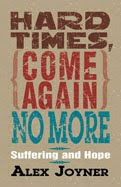
Stephen Foster, Job, the Canaanite woman—what do they have in common, and what can we learn from them? Pastor and storyteller Alex Joyner takes us deep into the lives of these three people, exploring anger, audacity, hope, and joy. Through it all, he poses the question: Why do we suffer?
Hard Times, Come Again No More is a exploration that affirms the goodness of God, the reality of evil, and the wonder and tragedy of living in hard times
Alex Joyner is the author of Restless Hearts: Where Do I Go Now, God? and writes for the popular FaithLink adult studies and the online magazine Catapult. A published poet and photographer, he has served as campus minister at the University of Virginia and is now pastor of Franktown United Methodist Church on Virginia’s Eastern Shore.



 Posts
Posts


