24 December 2006

Moving Mary to the Front of the Nativity Set

Luke 1:39-55
In those days Mary set out and went with haste to a Judean town in the hill country, where she entered the house of Zechariah and greeted Elizabeth. When Elizabeth heard Mary's greeting, the child leaped in her womb. And Elizabeth was filled with the Holy Spirit and exclaimed with a loud cry, "Blessed are you among women, and blessed is the fruit of your womb. And why has this happened to me, that the mother of my Lord comes to me? For as soon as I heard the sound of your greeting, the child in my womb leaped for joy. And blessed is she who believed that there would be a fulfillment of what was spoken to her by the Lord.
And Mary said,
"My soul magnifies the Lord,
and my spirit rejoices in God my Savior,
for he has looked with favor on the lowliness of his servant.
Surely, from now on all generations will call me blessed;
for the Mighty One has done great things for me,
and holy is his name.
His mercy is for those who fear him
from generation to generation.
He has shown strength with his arm;
he has scattered the proud in the thoughts of their hearts.
He has brought down the powerful from their thrones,
and lifted up the lowly;
he has filled the hungry with good things,
and sent the rich away empty.
He has helped his servant Israel,
in remembrance of his mercy,
according to the promise he made to our ancestors,
to Abraham and to his descendants forever." --NRSV

Sometimes I need a reminder to get my theology straightened out. I got one one day early on in my career as the campus minister at UVA. I was walking across the grounds there in Charlottesville with Joel, who was about five at the time. I got caught up in the beauty of the place and as we were walking towards Alderman Library I said, "Joel, do you know who created this university? It was Thomas Jefferson." He had already heard a lot about Thomas Jefferson in his young life, being the son of a UVa grad and of the Wesley Foundation director. He was quiet for a minute but then he said, "Yes, but God created everything else, right?" That was my reminder. Be careful what you teach!

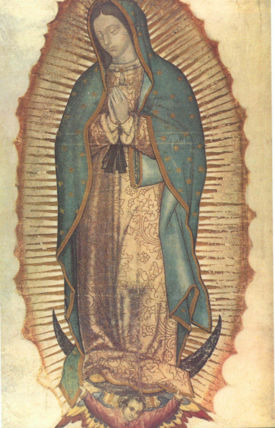
I got another reminder once in a Mexican desert. It was early December and I was doing some scouting of mission projects for the Volunteers In Mission program in the state of Puebla, about 200 miles southeast of Mexico City. I was riding in the passenger seat of a Volkswagen Beetle with my knees up around my chin, choking on all the dust pouring in the windows. We were in the middle of nowhere, there was not a village to be seen, when we came upon a group of people marching up the road. There were about twenty people including men, women and children all in simple dress. They were carrying a placard with a picture of the Virgin of Guadeloupe, an image of the Virgin Mary which is the most revered in all of Mexico. The church member who was driving the VW Bug told me that they were pilgrims on their way to Mexico City to celebrate the feast day of the Virgin which is a national holiday in Mexico--Dec. 12. They were walking over 200 miles to be there, all because of this woman. I suddenly realized that the Virgin Mary, who is so often overlooked by Protestants as a "Catholic thing", was a figure that could make people walk through the deserts to see her. My theology was being adjusted again.

The Mary I grew up with in my Sunday School lessons in the Methodist Church was a very unsatisfying figure in a lot of ways. Unlike Moses, who argued with God, or Sarah, who laughed when God said she would have a child, Mary seemed incredibly passive to me. The angel Gabriel appears to her and informs her that she is about to become an unexpected expectant mother and after asking the obvious question of "How?" she merely says, "Here am I, the servant of the Lord; let it happen as you say." Where is the struggle, Mary? Where is the "Wait a minute, Gabriel, you must have the wrong girl"? Aren't you going to say more to God to call into question this radical upsetting of the apple cart?

So for me and for most Protestants, Mary slipped quietly to the back of the manger scene, content to be shrouded in blue and shrouded in obscurity. We sympathized with her plight as a mother before her time in a culture where she would have been a scandal, but we really were more content to let her be an uncomplicated model of piety and a set piece in the Christmas pageant. Place her on the donkey under a brightly starlit sky, or in the manger where soft light falls on her face and the child she holds. Much more than that we can't bear and we don't have to, unless we read the Magnificat.

Which we just did, though you may not have recognized it by that name. In one of the most amazing pieces of poetry in the Bible, Mary moves from the back of the manger to the position of chief interpreter of the events of Christmas. Magnificat is the Latin word which begins this wonderful speech and it serves as a convenient title for a speech that is as joyful as it is revolutionary. When Mary speaks, no Sunday School lesson in the world can make her into a simple piety. She knows God didn't come into the world in Jesus just to give us characters to build TV Christmas specials around; she knew that God was coming to rattle our cages and shake the earth beneath our feet. She also knew that that was good news.

In the midst of the chaos of her pregnancy and the uncertainty of her situation, Mary finds the voice to say, "My soul magnifies the Lord and my spirit rejoices in God my savior." Like the Old Testament figure of Hannah before her, when Mary found that she was carrying a child of promise, it became a promise not only for her, but for her nation and for the poor. "God," she says, "is powerful and will remember the people of God. God will lift the lowly and level the lofty. God will feed the hungry and send the rich away empty-handed." This is scandalous stuff. Even today, maybe especially today, this is scandalous stuff. To say that God's coming is a threat to the established order in a world clinging to the stability that order ensures is scandalous stuff. To say that God's coming is a challenge to the rich in the richest nation on earth is pretty hard stuff to hear. Thank you, Mary, you may return to the back of the manger now.

But she won’t go there, because Mary has been visited by angels and she's got her finger on the pulse of the life God offers. What she is suddenly able to see is what prophets and John the Baptist and desert wanderers have always seen--that security is not always to be trusted and chaos is not always to be feared. Sometimes God can be found in the place where the world is turning upside down. Sometimes God is in the unexpected place waiting for us.

So here we are at the end of the pre-Christmas season. The shopping and the traffic and the stresses all stretch us and turn us and churn us until Christmas, if it comes, seems more like an achievement than a celebration. Yet even in the stress and strain something new is being born in us and it might even be called knowledge. It might even be called hope.

Beyond our immediate lives, though we don’t have much time to think about it because of the crush of the season, there is a world that is equally chaotic. We’re only vaguely aware that things are not going well and our leaders seem as lost as we are and the violent threats continue. A conference gathers in Tehran for people who deny that the Holocaust, the slaughter of millions of people by the Nazis, ever happened and the president of Iran says that Israel will be wiped out. It’s a threat. Bombings and kidnappings and torture continue in Iraq and Afghanistan and elsewhere. We don’t want more chaos like that.

Then yesterday I read a news story about a poll in Great Britain. Britain is often called a post-Christian culture, along with much of Western Europe, because so few people attend church. But the new poll finds that Britons have not only left the churches, they now see them as a threat. A poll by the Guardian newspaper showed that 82% of people in the United Kingdom say they “see religion as a cause of division and tension between people.”[i] God is seen, not as the refuge in the face of violence and turmoil; God is the source of the problem. When we see the violent ways in which suicide bombers express their faith, that’s one thing. But there is a growing sense in this post-modern world that religion itself is threatening. “Why do these religious leaders stir people up with notions of eternal life and returning saviors? Why bother with such archaic notions that only rile people up?”

I bet you didn’t think of yourself as a revolutionary when you walked through the doors of the Church this morning. Not many of us see children dressed as bathrobe shepherds and young people singing Christmas carols at Heritage Hall and older people knitting prayer shawls and families lighting an Advent wreath and single people meeting for Bible Study as threats to the international order. When we take water from the fount and place it on an infant’s head to recognize her new life in Christ…when we take a loaf of bread and break it and bless a cup and share it we don’t think of these things as anything more than the somewhat unusual family traditions of the Christian people. But Mary knows that what God is doing is threatening. Those Britons who responded to the poll are right. What God is doing threatens a world that is addicted to war with the promise of peace. God threatens a world prone to poverty and injustice with a new order where those on the underside are moved to the top. God threatens a society where there are so many other labels for who we are – you are a consumer, a victim, a customer, a poor person, a rich person, a geek, a nerd, a drama queen – and challenges them all as inadequate to explain how God sees us. We are not any of those things because God knows us only as children of God.

A Mary who can help us to see the good news in the bad news is worth walking through the desert to see. A Mary who helps us see the world as God sees it is deserving of more than a veil of soft light and flowing blue robes. A Mary who leads the praises of a God who upsets the order and establishes change for the poor and the lowly is the Mary I see now that my theology has gotten adjusted.

And on the 12th of December, this year again, on a hillside on the northern edges of Mexico City, thousands of pilgrims ended their dusty journeys with a celebration of joy. They raised their placards and fell to their knees and glorified the God who saves--the God of Mary, the God of Jesus Christ, the God of you and me.

And henceforth, all generations shall call us blessed. Thanks be to God.

[i] Julian Glover & Alexandra Topping, “Religion does more harm than good – poll”, Guardian, 12/23/06.

10 December 2006

Reasons to Be Ready

Malachi 3:1-4
"Look, I am sending my messenger who will clear the way before me. And suddenly Adonai will come to his temple, the one whom you seek; and the messenger of the covenant, in whom you delight, will surely come," says Yahweh, Lord of hosts.
But who can endure the day of his coming? Who can stand when he appears? For he is like a refiner's fire and the lye of the launderer. He will sit as a refiner and purifier of silver. He will purify the Levites and refine them like gold and silver. Then the offering of Judah and Jerusalem will be pleasing to Yahweh as in the days of old and as in former years.

I have to tell you that I really struggled with the message this morning. I mean, did you hear the passage from Malachi that we read? Did you hear the words of John the Baptizer? They’re not exactly comforting images. Here we are only a little over two weeks from Christmas (don’t panic!) and we are in the midst of the Christmas preparation marathon and we would like to hear some words of hope and light and some soft music and be reminded of how comforting Christ’s coming is for a world that knows so much stress and sorrow.

But that’s not what we get today. Malachi says, “Yes, God is coming, but who can endure it? Who can stand when he appears? He will be like the refiner’s fire or caustic lye soap.” John the Baptist says, “Yes, the promised Messiah is coming, but you’ve got to get prepared. Mountains will have to be leveled and valleys be filled in. You will have to have a baptism of repentance. Don’t expect that this Messiah thing will be easy.”

So what can I say this morning that will sound like good news? What can I say that sounds like joy to the world or angels from the realms of glory? Where is the word we need to hear today?
Because if you are like me, you’re already feeling like you’re headed to tinsel tension, silver bells stress, and overmuch overload. You’re already feeling like you’ve eaten too much, wrapped too little, and complained too often. On the national front, our leaders seem helpless, our world seems disturbed, and our budget seems busted. And at church there’s this sense that something important is supposed to happen. The candles are lit. The crismons are on the tree. The carols are beginning to be sung. It’s beginning to look a lot like Christmas, but we’re not entirely sure what that means. We want to feel the richness and the depth of the season – we want to be swept up in it, like we were as children…to know the magic and to believe as maybe we once did, that animals can talk on Christmas Eve, that up on the housetop there are reindeer paws, that a manger in Bethlehem cradles a king. We want to believe this. Surely the stars are brightly shining. Surely unto us a child is born, unto us a son is given. Surely there is joy to be spoken to the world for a lord is come. But there are days, aren’t there? There are weeks, aren’t there? There are years, aren’t there?, when we wonder how Christ will come into this world that seems so closed off to God. When we wonder how we can hear good news.

So I read Malachi and I think – refiner’s fire…lye soap. There IS a message in here. God is trying to get our attention. There are reasons for us to be ready. There are things that need to be purified. There are things that need to be cleansed. Something’s gotta give and I believe it’s me.

After much struggle, I think this is the thing that I need to say today: something’s gotta give in order for us to be ready for Christmas and that is good news. Let’s look at that from two perspectives – one old and one new.

First, the old. We might wonder what meaning the Old Testament prophet Malachi has for us today. After all, he is talking about a messenger who would come to restore justice, to restore right worship, to open the way once more between God and the people of Israel. Malachi was talking to a people who had returned from exile and who were trying to reestablish a kingdom in the land of their ancestors. And they were doing a pretty poor job. They had strayed so far from God that they were confusing evil with good. They were questioning whether God still cared about how they lived and whether there were any consequences for not living right. It was a time long, long ago, and surely we don’t have those same problems today. But of course, we do. We also live in a time when evil is confused with good…when people question whether God cares about our ethical choices and whether there are any consequences for making bad choices. You know that’s true.

But Christians look back on this prophecy from Malachi and they wonder, “Why are things the same if the messenger that the prophet talks about has already come?” The messenger was the precursor, the Elijah figure, who would come to prepare the way for the coming of the Lord. Christians saw that figure in John the Baptizer, the one who came to prepare the way for the coming of the Christ. And in Jesus Christians see the one after whom nothing could be the same. When we beheld Jesus, we saw the God who had taken our form and lived our life and died our death and revealed to us what God was up to in the universe. We saw the end of all things, the purpose of all things, come to pass in our time, in a baby, in a manger, on the road, on the sea, in the boat, in the Temple, up a hill, and upon a cross, and through an empty tomb. Why is it then, after all of this, that we are still not any closer to being what God intends us to be? Why are we still waiting for Messiah to come?

What is different…what makes this time different…is that we have something new to do because we know the end of the story.

Now the new perspective. Once I worked as a youth director at church-related community center in West Dallas. West Dallas is the inner city and the inner city in Dallas has the same reputation as the inner city everywhere – it is the place where dreams go to die. And it certainly seemed well-deserved when I arrived there, full of optimism and a dangerous amount of theological education – two years at a United Methodist seminary!

I quickly became very discouraged with what I saw. West Dallas was severely divided. Our community center was located right near the dividing line. I could even name you the street. Vilbig. North of Vilbig, West Dallas was mostly black. South of Vilbig was mostly Hispanic. We were one of the few community centers that served both communities.

I coached basketball as part of my job there and I spent hours with my players. We got to know each other pretty well. Once I asked them what it was they wanted to be when they grew up. Just about every one of them said, “An NBA basketball player.” Thomas said that and he was probably going to have the height to do it. But Squirrel said that, too, and there was no way Squirrel was going to make it. He could do many things, but being an NBA star was not going to be one of them. I encouraged them to dream big, but I also tried to give them some other dreams, and other possibilities.

But a funny thing was happening to my own dreams. For the first time in my life, I was feeling like an absolute failure. The problems were so overwhelming and the resources so limited. Families were so broken and the despair so pervasive and the children so wounded and I was so different I might as well have been from another planet. I was also working in a situation without a whole lot of guidance. I had incredibly good people to work with but they were each so overloaded with their own stuff that I didn’t get much help. I was free to develop the program as I wanted, but that was exactly the problem – I was free…and alone.

I wasn’t alone forever, though. I struck up a friendship with a guy by the name of Juan Prieto. Juan worked for the Health Department at the time, but his great passion was to make West Dallas a better place. Juan had come from Colombia where he had experienced all the violence of the drug wars that were going on at the time. He knew the worst that life had to offer, but he was irrepressibly cheerful. Juan was the one who was given the thankless job of handing out flyers about a mandatory measles vaccination to every household on public assistance in the neighborhood. That must have been ten thousand houses. But he was so upbeat and he made it seem like such a party that he got us, youth workers from other agencies, to volunteer to do the job with him. It was like Tom Sawyer whitewashing the fence. I still remember handing out all those flyers in some really rough neighborhoods and thinking that it was about the most fun I’d had in weeks.

The thing that made Juan so effective was his vision. He knew what West Dallas could be. He shared that vision with those around him and when he found companions for it, he moved us to action. The vision was not going to be realized without some changes and he was motivated to work for those changes, even when it meant a lot of work that seemed really hard to those on the outside.

Juan Prieto is still like that. Suzanne and I got to eat with him and his wife last February when we were back in Dallas. We reminisced about our adventures creating a Teen Advisory Council and starting a talent show and starting teen pregnancy prevention programs – things I would never have done had I not been dreaming with Juan about what could be. And Juan is still doing those things.

Why am I telling you this? Because the message is the same – when you know the end of the story, you have something new to do. I was absolutely stumped by that youth director job. Here I was trying to bring good news to the inner city and I couldn’t even hear God’s good news myself. But once I caught a vision of what God intended for West Dallas, a vision carried by Juan, I knew that there were new things to do, and we did them.

Christians talk a really good game at Christmas time. We make some really radical claims about what God is up to in the world. We make a huge fuss over the story of a baby in Bethlehem. We say that nothing could ever be the same after God came to us in Jesus.

But our words fall flat when we don’t claim that vision and change our lives as a result. My favorite question to ask in Bible Study is, “Well, if we take this passage seriously, what’s got to change?” The assumption built into that question, of course, is that we haven’t been taking the passage seriously and that there ought to be some consequence to our reading.

So ask that question of Malachi. Ask that question of John the Baptist. Ask that question of Christmas. If we take the coming of the Messiah seriously…if we take the message of repentance seriously…if we take the language of a refiner’s fire seriously…if we take Christmas to be more than just a wish-fulfillment fantasy, what’s got to change? Will we still pray for peace on earth and not work for its coming? Will we remember the poverty of the stable and not think about those whose poverty stunts their lives in our day? Will we sing about the gifts the magi brought to the child and withhold our own gifts to the work of God’s reign? Will we talk about love coming down at Christmas and continue to hate our neighbor? Will we let angels sing the heavenly chorus and not join in with praise of our own? Will we admire the shepherds’ immediate response to the angel’s call and explain away our own failures to do what we feel called to do?

This to me is the hard struggle of these passages we read today. It’s not that I don’t have the capacity to be what God wants me to be. It’s not that I am not able to be ready for the coming of Christ. Because Christ has already come and done what he did and promised to be with us to the end of the age, I know, on a certain level that I can do it – I can do all things through the one who strengthens me. But I often fail to be what I know that I can be. The things that I feel are my most persistent character flaws and personal weaknesses are things that I can address if I will only let go of the fear of change. Like the 5th century Saint Augustine I am a master at praying, “God, give me wholeness, but not yet.” I’m afraid to live without these chains I place upon myself. Something’s gotta give, and it’s me.

This Christmas, as I look around the world, I see very few people like my friend, Juan Prieto. This is a cynical age and we are prone to disillusionment and criticism. We find it far easier to find the flaws in the plans on offer than to offer up a vision that might cause us to actually risk something of ourselves, that might ask us to express our deepest longings, desires and passions for change. We would not go to the desert like John the Baptist. We would not dare to suggest that something within us needs to change. We are more than willing to wait on a savior as long it doesn’t require anything of us.

But this Messiah we wait on does require something. It’s not that we have to earn this salvation that Jesus brings. Don’t confuse this with a works righteousness argument. God’s grace goes before. It always goes before. But if we take God’s grace seriously, what will have to change in us? Something’s gotta give. And the process of getting ready is a continuing process of opening ourselves to God’s fire, letting it burn away the impurities within us, and moving us to action in this world.

I know I’ve used this quote before, but it says to me what needs to be said to a waiting people. Steven Long, a professor at Garrett Evangelical Seminary says, “Christians are people who put themselves in places they would not be if the gospel they believed were not true.” Christians are people who put themselves in places that they would not be if the gospel they believed were not true. Where do you need to put yourself? What’s the deep knowledge that you are hiding that needs to be expressed in your words and deeds? What do you need to confront that’s keeping you from God? Whom do you need to love?

Christmas is coming. The way must be prepared. Thanks be to God.

03 December 2006

When Christmas Comes to the Unprepared

1 Thessalonians 3:9-13
For what thanks can we render to God for you in return for the joy with which we rejoice before our God because of you? Night and day we pray deeply that we might see your face and supply whatever is lacking in your belief. Now may the very God who is our Father and our Lord Jesus make straight our path to you, and may the Lord intensify you and fill you to overflowing with love for each other and for all we are feeling for you. So may your hearts be established: faultless in dedication before our God and Father at the coming of our Lord Jesus with all his saints. Amen.


It’s the question that you have already begun to hear, no doubt. Now that Thanksgiving is past. Now that December has come. Now that the Advent wreath and the poinsettias have made their appearance in the sanctuary (with more to come tonight), the question is on everyone’s lips when we don’t know what else to say: Are you ready for Christmas?

What a horrible question to ask someone! I ask it myself from time to time, but when I think about it – what a horrible question! As if there isn’t enough anxiety in the air already, we go around asking each other if we are ready for Christmas when the number one thing we feel unsettled about in this season is whether or not we are prepared for the holiday. Of course, we’re not ready and if you tell me that you ARE ready for Christmas, well, that’s only going to make me more anxious. “He’s got it all done. Why can’t I have it all done?”

But Advent comes to ask us a different sort of question. When we talk about being ready for Christmas, we are usually talking about presents, decorations, travel plans, Christmas cards. But Jesus is not really concerned about any of those things. Advent is the season in which the church asks us to think about not are we prepared for the coming of the relatives, but are we prepared for the coming of a savior. I don’t bring this up because I want to add one more layer of anxiety onto our already overloaded holiday schedules. I bring it up because Advent is a gift – an early holiday gift – that can help us to be truly ready for Christmas and which has the potential to pull the anxiety rug out from under all those other concerns we have at this time of the year.

Now the readings of this first Sunday in the season may not seem to say that. When we read the gospel story from Luke this morning it sounded a little…well…dark and they may have caused you to begin worrying. Jesus is speaking to his followers in the last days before his crucifixion here and he tells them that things are going to be bad in the future. There will be signs in the heavens and signs on the earth. There will be upheavals and trials. And all of this will be the sign that Christ is returning to make all things right. It was to be good news for them because for a persecuted people, which they were going to be, the end of the way things are was the end of their suffering. But for those of us who are not persecuted for our faith, the end may seem less welcome.

In fact, for us, living twenty centuries after Jesus’ words to the disciples, we may even begin to doubt these words…to doubt the second coming of Christ…to doubt his advent into a troubled world. We may even not wish for it to come. I saw a bumper sticker once that said, “Jesus is coming. Look busy.” It was a humorous way to talk about a serious PR problem that the Second Coming has – We’re not sure we want it and we’re not sure how Jesus will treat us if he does return. That bumper sticker presents us with the image of Jesus as a grouchy school teacher or an unloved boss leaving the class or the workers to play but then coming back to punish them for misbehaving.

But we have another reading from the scriptures today and I want to listen to that one, too, because it gives us a much different sense of what this second advent of Christ is all about, something that may help us to be prepared for Christmas, which is about Christ’s first advent. Along the way I want to ask you to listen for three counterintuitive rules for Christmas preparation. You can call them Joyner’s Advent Advisories, if you like.

So let’s see what we have. Paul’s first letter to the Thessalonian Christians is probably the oldest letter we have in the New Testament. It was most likely written before all of Paul’s other letters and before the gospels even made their way to paper or papyrus. So what we have here is a glimpse of how the first Christian communities saw what they were doing and what it was they were called to do as they served God.

Thessonika was an influential city in Greece. It occupied a key spot on the major Roman road that cut across the north of Greece which meant that it was a crossroads town, a place where the currents of the world met. To be a Christian in this place meant to be a significant minority and a persecuted minority. Christians quickly became a threat to the status quo and to the empire. Their allegiance was to someone beyond the emperor. Their allegiance was to Jesus.

But despite their marginal status in the world, the Thessalonian Christians had a strong church and Paul loved them. Paul didn’t just establish a church in Thessalonika and go off and forget them. He wasn’t a “hit and run” apostle. He continued to have a very strong affection for them and his letter is laced with the joy he feels in knowing them. And above all he gives thanks to God for them.

Which brings me to my first Advent Advisory. If this passage gives us a lens to see what Christians ought to do as they await Christ’s coming again, the first thing we see is this emphasis on giving thanks. To update that a little bit, I would say, “The best light display is a candle.” Oh yes, I know a candle is about waiting and watching, but it’s also about thankfulness and an expression of hope in the God to whom we give thanks. You light a candle in a window to remember a loved one serving in the military far from home. You light a candle in the window to guide a friend to a safe haven. You light a candle in the advent wreath to give thanks for the joy we feel in this place in this season.

There’s a movie out right now called “Deck the Halls,” and the premise is that two neighbors get into an all-out war with each other to see who can put up the greatest light display in the neighborhood. I haven’t seen it but I imagine that they take it to ridiculous extremes and forget the real meaning of Christmas. I don’t know what the heartwarming ending looks like but I bet it doesn’t end with a candle.

There is a lot going on in this season and I love to see the lights on the houses and buildings. The Christmas specials on the television sometimes remind us of what’s important. Linus reciting the Christmas story on an empty stage in the Charlie Brown Christmas is still one of my favorite moments. But we need the story we hear here, too. We need to know that there is something different about the lights in the wreath. To walk into the church is like walking into an alternate reality. The world may not know that Jesus has come to save it and to turn it upside down and to redeem it, but we do know that. We do believe it. And we need to live in this world.

My second Advent Advisory? What the world needs now is love. Maybe Hal David and Burt Bacharach came up with that first, but I’m borrowing it. This is what Paul talks about, too. You may not have noticed it in the midst of the dark images in the readings, but laced throughout Paul’s letter is the language of love. He says that he is praying earnestly to see their faces again and that is born of his love for them. And his prayer for them is that they may be intensified and filled to overflowing with love for each other and for all. What are they supposed to do while they await Christ’s coming? Love!

Now this doesn’t mean sticky sentimentality. For a community that was being forced underground by oppression, there was no room for sentiment. The Thessalonians were not going around sending each other chocolates and Hallmark cards. The love the shared was born of deeply sharing each other’s lives and recognizing that Christ’s call was not just for them but for all the world, particularly the poor and outcast.

We live in a world which has largely ignored the power of love to transform things. We may be discovering the limits of the other kinds of power we possess, but we have surely forgotten how powerful love can be. Martin Luther King, Jr. and the other leaders of the nonviolent civil rights movement had to work very hard to keep this Christian truth at the forefront when they were working to overthrow the effects of racism and segregation in the South. There were a lot of folks who felt that the walls would never fall without violence and struggle. But there were folks, Jews and Christians, who believed that love has its own power and that overcoming segregation was good, not only for those being oppressed, but also for those who were dominant. So they trained diligently in how to live out love in a prophetic way. They were witnesses to a different order and a different kingdom and many of them drew their inspiration from the love they had known in Jesus Christ.

What are we doing to be witnesses to that kind of love in our community and our world? Are we reaching out to our neighbors in need? Are we speaking out and joining hands with our neighbors?

This week, our clergy group met again with guidance counselors in the Northampton School system. Karen and I were there representing our church. We began to make plans for another series of cottage meetings to bring together our community, across racial lines, to talk about how we help our students succeed and how we enlist them in leading our community when they graduate. We want them to know that we want our young people to consider coming back when they go away to become teachers. To come back and better the community with new businesses. To come back as people who can help us overcome the barriers that remain. That is a work of love.

Finally, my third Advent advisory, which also is drawn from Paul’s words: Jesus is coming every day. Jesus is coming every day. It’s not just at the end of history that we should expect Christ’s return. Christ is lord of every morning and the kingdom, so he says, is among us and at hand. So our lives need to be about the work of the kingdom every day, not just in special seasons of the year.

There are people who need to hear Christ’s good news every day. There are people who need to have their lives turned around every day. There are people suffering every day. There are people wondering what their purpose in this life is every day. There are people giving their lives over to idols and distractions and drunkenness and drugs and dissipation every day. There are people who doubt their worth and doubt that they are loved every day. There are people struggling to stay on the path every day. There are people whose relationships are foundering every day.

But there are people overcoming all of this every day. There are people who know that the kingdom will not be brought in by their efforts but who work for it anyway every day. There are people who know how much their lives have been transformed by love and who live out of that every day. There are people who find healing and hope in prayer every day. There are people who know that little children and surly teenagers and difficult parents all alike are children of God and are deserving of our thanks every day. You know what you call these people – Christians because they do all this knowing that Jesus Christ is coming every day.

If we live with this expectation – that the return of Christ is not just a story we trot out several times a year to increase our anxiety but a promise to be realized every day – then it changes everything. And it begs the question – what are you going to do this Christmas? How could it be different for you? How will you give thanks for this community and for the ways you have known Christ through it? What’s the candle of thanks you light? How will you love others in a visible way? Who is God calling you to love? What are the practices you can undertake to help you be ready for the day? In prayer and journaling, in meditation and meeting together with other Christians, in worship and devotion – how are you meeting the Jesus who comes to you each day?

Don’t have any anxiety about Christmas. It’s coming and will come whether you have every ornament on the tree or not. The challenge for you on this first Sunday of Advent is to open the gift that is this season and to see what it is challenging you to do to be prepared for the coming of Christ. Jesus is coming. Don’t look busy. Rejoice. Thanks be to God.

26 November 2006

When Jesus is not all the world to me


John 18:33-37
Then Pilate entered again the praetorium and summoned Jesus and said to him, “You are the king of the Jews.”
Jesus answered, “Do you say this on your own or did others say this to you about me?”
Pilate answered, “I am not a Jew, am I? Your own people and the high priests handed you over to me. What did you do?”
Jesus answered, “My kingdom is not of this world. If my kingdom were of this world, my servants would be fighting in order that I am not handed over to the Jews. But now my kingdom is not from here.”
Then Pilate said to him, “So, then, you are a king.”
Jesus answered, “You say that I am a king. For this I was born and for this I came into the world – that I might bear witness to truth. Everyone whose being is from truth hears my voice.”

There are times when I wish that Jesus was NOT all the world to me. You know that old song—“Jesus is All the World to Me”? There are times when I wish that wasn’t true. This is a test, folks. I’ve got to do a lot of preaching to redeem myself from that beginning, don’t I? I just thought I’d get your attention at the beginning of the sermon today.

Now what would make me say such a thing? Well, let me tell you about a dinner I once attended. In 2001, shortly after the attack on the World Trade Center and the Pentagon, I went to my first Ramadan feast. Now that doesn’t mean I had a feast at the Ramada Inn. It was a Ramadan feast. I was director of the Wesley Foundation at UVA at the time and the Islamic Society of Central Virginia had rented the dining hall to hold a feast to recognize the Muslim holy month of Ramadan.

To tell you the truth, if it hadn’t been for the noticeable absence of pork and beans and fried chicken, I would have been tempted to call it a potluck dinner, but no, this was a Ramadan feast and the Muslim community from all around Charlottesville, which is not very large, gathered in the dining hall. There was rice and fruit and garbanzo beans, and somebody brought burritos—it was quite a spread.

When we hear about Ramadan—IF we hear about Ramadan--we often hear it called a month of fasting, but dedicated Muslims only fast during the daylight hours as a way of rededicating themselves to God and strengthening their spiritual practices. Each day before sunrise they eat a meal and then, as soon after the sun sets as is possible, they eat a date to break their fast, offer prayers to God, and then eat a meal, which is often pretty big. During the month they are also supposed to give to the poor and read through the whole Qur’an. What if Christians read the whole Bible through every Lent? Actually that’s not a bad idea, is it?

Well, I was invited to attend the dinner. I accepted because it seemed to me to be an important thing to do. As a university community we had been trying to build some bridges with the Muslim community after September 11. Right after the attacks we held an interfaith vigil on the Lawn. Later we had an interfaith dinner of Methodist, Presbyterian and Muslim students and talked about what it means to be a person of faith and an American. We recognized that we lived together and didn’t know much about one another and so were trying to remedy that.

But here’s where I found myself wondering about Jesus that night. The head of the Islamic Society welcomed the two or three of us who had accepted their invitation for dinner and thanked us profusely for coming. He should have been on the Chamber of Commerce because he praised Charlottesville up and down for being a great place to live, and a safe place to live for Muslim people, and there were people from all over the Islamic world there. Then he said, “I’m not going to talk much, because I want you to talk with each other at the table. But please ask questions and we will try to answer them. We must learn about each other if we are going to live together.”

So I did. I asked about how the Muslim calendar worked and what Ramadan was about. They asked me about the United Methodist Church and what happened at the Wesley Foundation. Then I started talking with a man who used to be a Baptist but who had become a Muslim, and if you can imagine what a Baptist Muslim would be like, well, that was him. He was a tall man, born in the U.S., wearing a turban and using phrases like, “You can’t just talk the talk, you gotta walk the walk, too.” And he was ready to get down to brass tacks. He wasn’t going to gloss over the issues.

He said, “Now Muslims believe in Jesus. We believe that he was one of the messengers sent from God to show us the way. He was a prophet the same way Moses was a prophet. What we don’t believe is all that stuff about Jesus actually being God. But what I’m challenging my Christian friends to do is to show me how Muslims are not doing the things that Jesus taught, because I believe that the things Jesus told us to do are the same for Christians as they are for Muslims. We’re supposed to love, we’re supposed to worship one God, we’re supposed to dedicate ourselves wholly to God. You can be a Christian or a Muslim and believe that.”

Now here’s where the “Jesus is All the World To Me” stuff comes in, because I think there is a lot to be gained by Christians and Muslims studying their scriptures together. When we go the Bible and they go to the Qur’an, we both find stories about Abraham. We both find stories about David. We both find stories about Jesus. We both find a God who demands holiness from the chosen people, who is a jealous God who wants us to love the one true God and the one true God alone. There are many ways things that it seems that we share.

But Jesus is not all the world to Muslim believers. What they say about Jesus and what we say about Jesus are very different. And, here’s the scary thing: I sometimes suspect that Jesus is not all the world to Christians. Oh, we sing those words and many other words like them. “Take the whole world, but give me Jesus.” “Victory in Jesus, my savior forever.” “Nothing but the blood of Jesus.” Are these ringing any bells? But I sometimes suspect that for all of our lip service to King Jesus, our lives look like they are more at the service of Oprah Winfrey or Dr. Phil or Rachel Ray. Oh boy, it’s getting personal today. When the pursuit of lower interest rates or higher living standards turn our labor into meaningless work, when we anesthetize ourselves with video games or alcohol, when we look forward more to lunch at the Burger King than to worship with Christ the King—there is a problem! And maybe you think I’m just preaching to you here. This is me I’m talking about! ‘We’ is me and I know that the challenge is to claim the Christ that makes Christians Christians.

What do I mean by that? Well, take a look at our bible passages this morning. In 2 Samuel we read about David recalling God’s promises to him. God has promised to build a kingdom, a dynasty, from David’s descendents who will rule over the people. It’s a promise that has resonated with God’s people ever since. There has never been a time when we have not been looking for a Messiah to come and bring redemption to the people.

That was certainly true in Jesus’ time when he appeared before Pilate. The charge against him was blasphemy against the promise God had made to David, though it had a political edge for Pilate. Pilate represented the empire. Pilate represented the real power of the age. The only king the Jewish people should have been recognizing, in his eyes, was the Emperor.
But the local leaders bring this wandering religious teacher in before him claiming that Jesus was a threat to the empire. Pilate looks him over and seems to be amused. “You are the king of the Jews,” he says. “What could you have done to earn this title?”

But Jesus seems to be living on another plane. He’s not from around here. He talks about a kingdom not of this world. The real threat to Pilate and the empire is not from his followers, who would be fighting if the kingdom were of this world. No, the real threat to them is their failure to see the kingdom coming in their midst – something far more threatening to the way things were than they could even imagine.

“So you are a king then,” Pilate says.

Jesus answers, “You say that I am king. For this I was born and for this I came into the world – that I might bear witness to truth. If your being is from truth, you will hear my voice.” It’s tough when you bring truth into the equation because it makes everything else small talk. Just like my Baptist Muslim friend did. We suddenly had to talk to each other from our hearts.

Paul talks about this in his letter to the Colossians. He knew that the new Christians he was establishing across the empire were going to have to talk from their hearts and talk about truth and it was not going to be easy. When Paul gave a pep talk to the new Christians in Colossae and he did it, not by telling the Colossian Christians how much they had in common with the people all around them, but by reminding them of the thing that made them different. They had not found salvation by discovering that Jesus Christ was a nice model hero that we could tell stories about and seek to emulate. They had not found salvation because Jesus was a good storyteller and a good teacher who was a real hit at parties because of the pearls of wisdom that fell from his lips. They had found salvation, their lives had been turned upside down, their world had been rocked, their paradigm had been shifted, they were thinking outside of the box because Jesus was God. Check that—Jesus IS God!

Paul is not going to let them explain away who Jesus is. He just piles on the descriptions. Jesus is the “visible image of the invisible God.” Jesus is “the firstborn of all creation—through him everything in heaven and on earth was made.” Before all things, he is, and everything in the whole cosmos holds together because of him. He is the head of the body that is the Church. He is the beginning, the firstborn of the dead. Through him God was pleased to reconcile all things in earth and heaven to Godself. You want the first light and the last word—it’s Jesus. You want the gospel truth and the final edition—it’s Jesus. You want the preview and the postlude—it’s Jesus. When Paul Harvey talks about the rest of the story, who do you think he’s talking about? It’s Jesus!

Now how do you take that Jesus to a Ramadan dinner? When Christians talk about Jesus this way, when we talk about Jesus this way, (because even when we’re not sure we’re being Christian, we do talk about Jesus this way), when we talk about Jesus this way we are staking a claim about the way the whole universe hangs together. We are saying that we have found one point in the whole great big cosmos, we have found one place in history, one moment in time, where God was revealed, where our salvation was assured, and where we began to understand who we are and what we were always meant to be. That one point of all the many others we could choose is in the life and death and resurrection of Jesus of Nazareth.

And because we look to this point and this person, we have something unique to offer the world. It’s uncomfortable at times. That’s why I said at the outset that there are times when I wish that Jesus was NOT all the world to me. I would like to reach out across that table to my Muslim brother with the Baptist language and say, “Yes, we are the same. Can’t we all just get along?” But if I go to the Ramadan table without my belief in Jesus, then I have nothing to offer to the conversation. Because if Christians have hope, it is a hope in Jesus Christ. If Christians work for peace, it is because they have seen God working for peace and reconciliation in Jesus. If Christians love others, even their Muslim and Jewish brothers and sisters, it is because they have seen sacrificial love in its most complete form as God poured out love for us on the cross.
The truth of the matter is that I cannot be reconciled to my Muslim brother unless I hold on to the Christ Paul talks about and expect the kingdom God promises David and believe that that kingdom entered the world in Christ.

But listen, that’s not even the best news. That’s not even the best thing that there is to say on this day, this Christ the King Sunday. Did you know that’s what this is? Christ the King Sunday. The last Sunday in the Christian year. The day when we look ahead to Christ’s final revelation as the ruler of all creation. Next week, we’ll be back to Advent and we’ll start to think about babies and shepherds and other smelly things that are the mundane stuff of Christmas. But today…oh, today I’m dreaming of a cosmic Christmas when we let it all hang out and we declare that Jesus Christ is not just a baby in a manger, but the ruler of the universe.

And why does it make a difference that we use this language for Christ? Why do we use all of these grandiose titles and high-falutin’ imagery? Isn’t it all a little…abstract?

Oh, friends, this is the best news of all. This is good news because the world is falling apart but the kingdom is just coming together. If we had any illusions that history had finally come to an end when the Berlin Wall fell, if we thought that there was nothing that could really threaten our sense of national security ever again, if we were deluded into thinking that a rising stock market and a comfortable future were birthrights we were all entitled to—if we thought any of those things, we learned again on September 11 that the world is still a dangerous place and that we are still vulnerable people. We learned in this awful war in Iraq and Afghanistan that struggles and trials and ideologies that threaten death and destruction continue. We have been shaken in ways we didn’t know we could be. We have grieved and worried about things we never worried about before. The world is not a place and we are not people who can say, “Every day and in every way we are getting better and better.”

But Christians have a different timeline. It’s a timeline that has a destination and we are all on a journey toward it. Sometimes we forget where we’re headed. Like when you go to the grocery store without a shopping list and find yourself wandering through the aisles saying, “Now what did I come for?” That’s us sometimes as we fall away from the promise, as we fall into sin, as we get confused and misdirected. But the journey set out for us in Christ has a destination. This train is bound for glory, this train.

So when we realize that this train is the one we’re meant to be on. When we recognize that our liberation, our salvation has already been won for us in Christ before we were even aware that we needed to be freed. When you see that the whole universe has its meaning tied up in Christ, well, things just look different. It’s not that we don’t grieve because we do--deeply. It’s not that we don’t hurt because we are often in deep pain. It’s not that we don’t believe in the reality of evil because it is at the heart of our story—there is no Exodus without slavery in Egypt and there is no resurrection without crucifixion on the cross—the powers of this world do have their day.

But we work for a new day and a new kingdom because we know that death can never have the last word. We work for justice because we know that violence cannot break the power of love. We work for peace because we know the Prince of Peace will throw down every sword. We proclaim hope because our hope is built on nothing less than Jesus’ blood and righteousness. We search for truth because the truth will set us free from every bond that keeps us from God. We worship because we know that all creation praises God and that at the name of Jesus every knee shall bow and every tongue confess that Jesus Christ is Lord. And we go to Ramadan feasts and talk about truth because we know that even though it makes us uncomfortable, Christ’s final prayer was that we should all be one—from every tribe and race and nation. And as we are reconciled to each other, we are reconciled to God. And as we are reconciled to God, we are reconciled to each other.

There is a welcome sign outside a dilapidated town in the grasslands of southern Oklahoma. I saw it one time on a trip Suzanne and I took in seminary. The sign is pockmarked from where some folks shot it up with a shotgun some boring night on the prairie when they didn’t have anything better to do. You can barely read the name of the town and you can barely read the words right under it. But the words say, “Welcome to Henrietta, Oklahoma. The best is yet to come.”

When the world seems darkest. When the world is falling apart. When you are tempted to say, “Where am I going and why am I in this handbasket?” In those times Christians say, “The best is yet to come.” And we say it with straight faces. And we believe it. And we stake our lives on it because Jesus is all the world to us. Jesus is all the world to me. My life, my help, my all. Jesus is all the world to us. Thanks be to God.

19 November 2006

Birth Pangs


Mark 13:1-8
As he came out of the temple, one of his disciples said to him, "Teacher, look how wonderful are these stones and how wonderful these buildings!"
Jesus said to him, "You see these great buildings? No stone will be left upon another stone; all will be destroyed."
As he sat on the Mount of Olives opposite the temple, Peter, James, John and Andrew asked him privately, "Tell us, when will this be and what sign will there be when these things are about to be accomplished?"
Jesus began to say to them, "Watch that you are not deceived. Many will come in my name saying, ‘I am the one,’ and many will be deceived. But when you hear of wars and rumors of war, don't be alarmed; it is necessary that this happens, but it is not yet the end. For nation will rise up against nation and kingdom against kingdom; there will be earthquakes in various places, and there will be famine. This is only the beginning of the birth pangs.

The little Methodist Church in Ahuatapec, Mexico is just a humble little concrete and brick building on the outskirts of town nestled into a cornfield. Ahuatapec itself is not much of a town, maybe 5,000 or so when the men come back for the weekend after working in Veracruz or Chiapas harvesting sugar or fruit or whatever is in season. The town sits on the high desert plains of the state of Puebla. In the distance in every direction you can see massive purple volcanoes topped with snow. To the east there is the Pico de Orizaba, the highest mountain in all of Mexico at 18,000 feet above sea level. To the north is La Malinche, named after the Indian woman who became a guide and mistress for Cortez when the Spanish came to conquer Mexico in 1519. And to the west there is Popo, usually belching out plumes of smoke that can be seen for hundreds of miles.

But they are all in the distance. Ahuatapec itself is just a spot among the maguey plants and cactus that line the desert floor. It's a small place, dominated by a large Catholic Church in the very center of town. To be involved in the life of the community in Ahuatapec is to be Catholic. You can't be mayor without being Catholic. It's difficult to run a business without being Catholic. And to be Methodist is to be in the minority, to be on the outskirts of town, to be an outsider in your own community.

Despite that fact, for ninety years there has been a Methodist congregation meeting in Ahuatapec. I got to go there – twice - on mission trips to help build the new church, which is the first church building the Methodists have ever had. It doesn't have gold filigree and fine art like the Catholic Church in town, but it is better than the cramped quarters of the Sanchez family’s one-room house, which is where they met for ninety years.

It was during my first trip there in 1994 that I had my first encounter with the tensions between Catholics and evangelicos--the generic name for all Christians who are not Catholics in Mexico. We were holding church services in the new church, which was just a shell of a building with open windows at that time. As I was trying to preach in my strange mixture of bad Spanish and English, a man in a van selling ice cream came to the front of the building. He parked right in front of the church and began playing music over the loudspeaker on top of his van at an incredibly high volume.

Now it was good music. I like Mexican music and I’ve been known to play it from time to time. Earlier in the week as we were digging trenches for the surrounding wall of the church we had loved hearing the music from this man's van because it meant ice cream and a chance to take a break from the work. But this morning it meant something else.

There was no question of him being able to sell ice cream at this spot. The church was in a cornfield, a long way from any other house. The ice cream man had come to play music in order to disturb our service, in order to let us know that the town had taken notice of what had happened and was not entirely pleased with what we had done. He stayed for perhaps five minutes, during which I just had to stop preaching. Then he drove off slowly and I had my first experience of what my Methodist brothers and sisters felt each day in that community.

A few years later I took a trip to another city in central Mexico with a group of college students. Again we worked with the local Methodists who were a distinct minority in the town. Petra, one of our hosts, told me about growing up in the town and how when she walked down the streets, Catholics passing by in cars would put their hands to their foreheads in the shape of a ‘C’ to signify that they thought she was cursed.

I don’t tell these stories to talk about how bad Catholics are. Far from it. In this sanctuary this morning we are people who are from Methodist, Catholic and many other Christian backgrounds. Somehow, here, we have managed to find a unity in Christ that churches in Mexico still haven’t found. But these experiences for me were the first to tell me what it was like to be singled out because of my faith. In Ahuatapec and Cortazar, and more so in other parts of the world, to have and claim the Christian faith can be a dangerous thing. The persecuted Church is not just something we read about in the Bible; it still exists and there is much we can learn from those who still suffer for their faith.

Have your ever suffered for your religious beliefs? Has there ever been a time when you felt that your very life was threatened because of your faith in Jesus Christ? Most of us have never known that sort of insecurity. We live in a land which may ignore Christians and which may downplay its Christian heritage, but it is, by and large, not a land where Christians are persecuted. Rightly we celebrate the work of Jefferson and Madison in guaranteeing freedom of religion. But it is not so in most of the world.

Believe it or not, Americans and Europeans are now a minority of the world's Christians. Most Christians are not white and they do not speak English. Most of them live in the Third World and most of them are poor. It has been estimated that in China, only about 2% of the population is Christian, but even if it is only 2% that would amount to over 26 million Christians.

What is also true about the majority of Christians is that they live in countries where freedom of religion is not constitutionally guaranteed and in many cases they live with the real threat of persecution. In China religious organizations that are not officially registered with the government are subject to regular harassment, particularly around the major Christian holidays of Christmas and Easter. Amnesty International reports that those caught participating in services considered illegal are often detained or fined, the usual fine being the equivalent of several months’ income. Imagine the impact it would have on your family if you lost three months income just because you came to church this morning.

In Sudan we hear about the genocide and warfare in the Darfur region and in the southern parts of that country. What we often don’t hear is that there are religious dimensions to that conflict. As the majority Muslim population has instituted Shari’ a law, they have also begun to exterminate the Christian population. Christians are sometimes sold into slavery to Muslims. The government policy there mandates the forced conversion of anyone who is not Muslim. In Iran, Christians, Jews and Baha'is all face violent crackdowns and death because of a government policy forbidding conversion to a religion other than Islam.

In Palestine, there has traditionally been a large minority of Palestinian Christians who held high positions of leadership. As much as 15% of the population was Christian as recently as 50 years ago. Today that figure is 2%. In Bethlehem, where Jesus was born and which has had a large Christian population, Christians are leaving in droves. The new wall of separation that the Israeli government is building goes right through Christian neighborhoods, cutting off people from their businesses and families. Palestinian Muslim gangs produce faked documents claiming that they are the legitimate owners of Christian lands and push the owners out. Ibrahim Shomali, a Christian restaurant owner, is selling out and leaving. He says, “Here is where Jesus was born and over there, across the hill in Jerusalem, is where he was crucified. We Christians now feel like we are on the cross.”[i] If the projections hold, there will be almost no Christians in the land of Jesus’ birth in fifty years.

Even in nations that are allied with the United States, Christians are endangered. In Saudi Arabia, which receives so much money from our nation for its oil and so much military aid, there are severe restrictions on Christian worship. It is officially outlawed and only marginally tolerated. Christians are arrested and lashed in public if they practice their faith openly. Bibles are regularly rounded up and burnt. Christians are arrested and tortured and can be legally executed if they have converted from Islam.[ii] Much of the wealth that the nation has accumulated in the past few decades has been used to support schools and mosques that advocate the expansion of the kind of Islam that has produced these laws.

There have been cycles of persecution like this before. In 1915, across the Middle East, but particularly in Armenia, there were devastating genocides that wiped out Christian cultures that had survived since Roman times. It’s also true that we can find times when Christians used their positions of power to persecute and kill Jews and Muslims. But what we face today is grim and one-sided. Philip Jenkins, who wrote a book on the changing face of Christianity says, “In the world as a whole, there is no question that the threat of intolerance and persecution chiefly comes from the Islamic side of the equation.”[iii]

We saw this played out recently when Pope Benedict, the leader of the Roman Catholic Church, quoted a remark from a medieval Turk that was interpreted as disparaging of Mohammed, the founder of the Muslim faith. In the violence that followed, the people who suffered were Palestinian Christians, whose churches were burned, a Somali Christian nun, who was murdered, and followers of the faith everywhere who suddenly wondered about their own safety in Western, religiously-tolerant societies. The Pope made his apologies, though I don’t think he should have, but he has said that he has a clear agenda for his upcoming trip to Turkey next week. He is seeking reciprocity. He wants to listen to Muslim demands for greater sensitivity to their faith, but is insisting on stronger protections and rights for Christian minorities.[iv]

Why is this important to us? Why should we spend time on this question? It cannot just be because we want to give thanks in this Thanksgiving time for this land and the freedoms we enjoy here. It’s a little crass to give thanks because we don’t suffer like our brother and sister Christians in Pakistan.

No, it’s important because we need to hear the challenge to us. Jesus says that we will hear about wars and rumors of wars, and indeed we do. There has not been a generation since Jesus’ death that hasn’t heard about these. But in the times we live in, the particular challenge we face is being faithful to the God we know in Jesus Christ, being open to those who do not know this God, and struggling (and that is the word) to create societies in which Christians and all peoples are free to practice their faith without fear of persecution.

It is also our challenge to create societies where we not only tolerate other religions but to engage them and confront them when they become violent and demonic. It would have been right for Muslims in the 12th century to question what Christianity had become if it could produce things like the bloodthirsty excesses of the Crusades. There are still areas where Christians should be challenged to examine their faith and practice. It is just as right for us to question what Islam has become when followers produce, in its name, horrors like terrorist cells, suicide bombers and beheading videos. We need some real, hard conversations about what it means that we live together and how it is that we shall do that peacefully and with full respect for each other’s existence. We need to love our neighbors enough that we will not ignore the distortions that lead to evil and death. And we need to recognize when we are putting others, and ultimately ourselves, at risk by not responding directly to threats. We need to respond as Christians, but we need to respond.

The words attributed to the German theologian Martin Niemuller following World War Two are just as appropriate to us today. Niemuller was credited with that saying, "When Hitler attacked the Jews, I was not a Jew, therefore, I was not concerned. And when Hitler attacked the Catholics, I was not a Catholic and therefore, I was not concerned. Then, Hitler attacked me and the Protestant church and there was nobody left to be concerned." When we stand with those who suffer and refuse to let them sink into oblivion, when we speak their names to those in power, we bear a witness that one day we may wish others would carry for us.

Coming into Jerusalem with Jesus near the end of his ministry, followed by great multitudes of people who were proclaiming Jesus as king, the disciples were convinced that their journey would end in glory. Standing among the great buildings of the capital city, in the shadow of the Temple, one of Jesus' disciples got carried away and said to him, "Teacher, look how wonderful are these stones and how wonderful these buildings!"

But Jesus would have none of it. He knew how fragile the institutions of the world are. He told the overawed disciples that the time was soon coming when not one stone would be left upon another, and within forty years his prophecy had come about. The Temple was destroyed and Jerusalem laid waste. And Jesus went on to warn the disciples about what their future really looked like. It was to be a time of persecution for them when they would be dragged before councils and hated because of his name. There would be war and famine and all manner of troubles. But these, Jesus said, were only birth pangs--like the pains of labor signaling the birth of new life.

We are blessed to live in a place like this, but the persecuted witnesses of the past and of today have seen the birth pangs in a way that we haven’t. Christians in the Sudan share the same gospel we do. They eat the same communion meal we do. They are baptized just as we are. But when they talk about the hope of the future, they see it in a very different way.

Archbishop Oscar Romero of El Salvador, who was murdered for his witness to Christ in a time of civil war in his country in 1980, said, "A church that suffers no persecution but enjoys the privileges and support of the things of the earth--beware!--is not the true church of Jesus Christ." That’s a challenging message for a privileged church.

In the book of Hebrews, the writer asks those in the church to "recall those earlier days when, after you had been enlightened, you endured a hard struggle with sufferings, sometimes being publicly exposed to abuse and persecution, and sometimes being partners with those so treated" [Heb. 10:32-33]. So what's it going to be? Are we going to be partners? Or shall we be forgetful? Forgetful of them, of Christ, and ultimately of who we are?

Thanks be to the God of the poor and the God of the suffering. Thanks be to the God of the persecuted, the God of Jesus Christ.

[i] “Christian population falls in Holy Land,” Brian Murphy, Associated Press Religion Writer, 11/11/06. Referred to hereafter as AP.
[ii] http://en.wikipedia.org/wiki/Persecution_of_Christians, Wikipedia
[iii] Philip Jenkins, The Next Christendom: The Coming of Global Christianity, [Oxford: Oxford University Press, 2002], p. 170.
[iv] AP